Skip to content
Wednesday, September 30, 2026

Bitcoin News

Bitcoin and Cryptocurrency Trends

  • Home
  • News
  • Exchanges
  • Bitcoin
  • NFTs
  • Blockchain
  • DEXs
  • Tokens
  • Case Study

Case Study: Tapbit – When Ugly Gets Even Uglier

Posted on November 28, 2025December 1, 2025 by Editor

Behavioral Red Flags
🚩

🚨 TAPBIT RED FLAGS — INSTANT VISUAL ALERT 🚨
  • 🚩
    Time-per-page collapses — humans do NOT browse ~10–17 seconds per page at scale.
  • 🚩
    Page depth jumps from 3 → 18 — classic forced loop behavior.
  • 🚩
    Mobile stuck under 1% — no real exchange operates with this profile.
  • 🚩
    Session duration rises while quality collapses — inflation, not engagement.
  • 🚩
    Ratios mutate overnight — only ring traffic shifts like this.

Case Study: Tapbit — How an “Ugly Exchange” Became Worse
⚠️

A forensic review of Tapbit’s SimilarWeb engagement data between late October and November 2025 — showing how artificial inflation destroys reputation.


Traffic Behavior = Reputation
📉

Traffic behavior is not analytics — it is reputation.

Listing teams, investors, market makers, partners — everyone checks one thing first:

Does the traffic look human?

Real behavior builds trust.
Synthetic behavior destroys it.

Tapbit’s November profile shows how reputation collapses when engagement becomes more artificial over time.


What “Ugly Exchange” Means
💀

  • 0–2% mobile — non-human footprint
  • sub-10s dwell — synthetic rotations
  • multi-page loops — automated navigation
  • desktop-only visits — ring sources
  • near-zero bounce — loop inflation

Mini Explanation: What Is the Traffic Ring?
🔄

The TrafficRing = shared synthetic visits passed between exchanges.

  • lands on special doorway URLs
  • does not load real content
  • rotates automatically between exchanges
  • inflates visits with no real engagement

Tapbit matches the ring signature perfectly.


October 2025 — Ugly Baseline
🟥


Tapbit in October — human engagement on the surface, but non-organic underneath
People stayed on each page for about 68 seconds — very human browsing time. Page depth (3.22 pages) and bounce (47.83%) also look normal. But mobile usage is only 0.72%, which exposes the profile as non-organic. Real exchanges always show strong mobile traffic; when mobile is almost zero, the entire footprint becomes synthetic regardless of how good the other metrics look.


November 2025 — Even More Artificial
🟥🟥
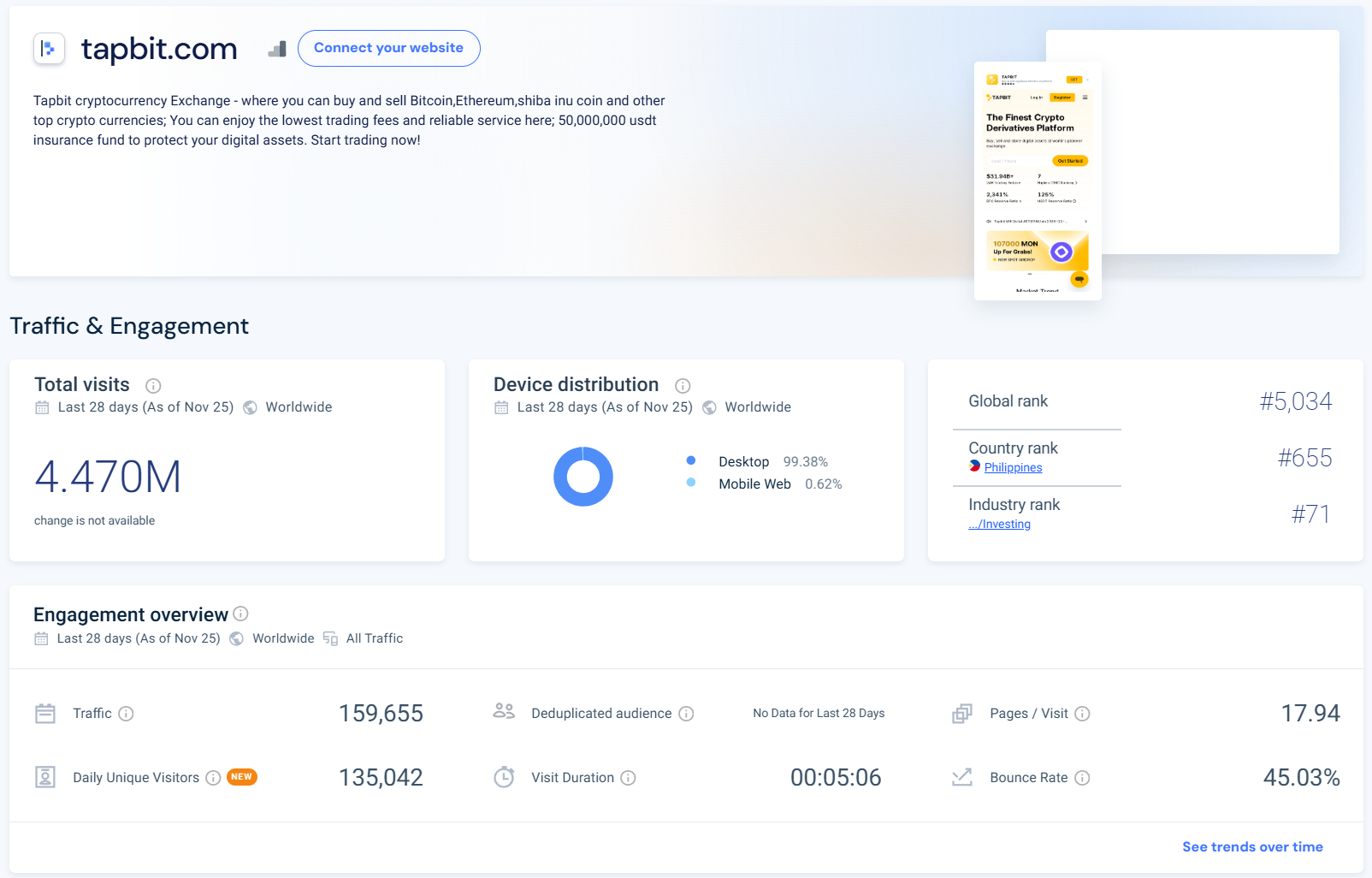

Tapbit – collapsed into full TrafficRing behavior.
People stayed on each page for only about 17 seconds (far too fast for real users), page depth exploded (18+ pages per visit), mobile usage is almost nonexistent (≈0.6%), and bounce stays unnaturally stable (45%) even as pageviews blow up — a classic forced-navigation footprint.


Reputation Impact
💣

Artificial engagement destroys credibility faster than anything else.

  • visible manipulation signals
  • stronger synthetic fingerprint
  • less trust from partners
  • bad optics for listings/MMs

Conclusion
📉

Tapbit was already synthetic — November pushed it deeper into artificial territory.
The harder they tried to look active, the less human the traffic became.

Real traffic builds trust. Synthetic traffic destroys it.


Full Framework: Real vs Fake vs Ugly Exchanges

For the complete breakdown of traffic tiers and forensic classification:


The Real, The Fake, and The Ugly — Full Report

Posted in Crypto Exchanges, Case Study, Crypto NewsTagged artificial engagement, crypto exchange analysis, crypto exchange case study, engagement anomalies, fake traffic analysis, non-human traffic, reputation damage, rotation loops, SimilarWeb case study, synthetic traffic patterns, tapbit, traffic manipulation, traffic ring behavior, ugly exchange profile

Post navigation

Previous: Case Study: Binance – Four Months of Real Human Traffic Behavior
Next: Case Study: Bitunix – Four Months of Stable, Human Traffic Behavior

Related Posts

  • Crypto Exchanges

CFTC Approves Spot Trading of Cryptocurrency on Registered Exchanges

  • admin
  • December 7, 2025
  • 0

CFTC Approves First Spot Crypto Trading Exchange in U.S.: A New Era for Regulated Digital Asset Trading CFTC Approves First Spot Crypto Trading Exchange in […]

  • Crypto Exchanges

EU Implements Ban on All Russian Cryptocurrency Activities

  • admin
  • April 25, 2026
  • 0

EU Council Approves Comprehensive Sanctions Against Russian Cryptocurrency Sector The Garantex Lesson: Why Targeted Sanctions Do Not Work What Exactly Is Banned Sector-Wide Ban on […]

  • Crypto Exchanges

World’s Largest Crypto Exchange Poised to Lose Access to the European Union

  • admin
  • June 16, 2026
  • 0

Binance Faces Potential EU Exit as License Application Set to be Rejected Amid New Regulations Binance Faces Potential EU Exit as License Application Set to […]

Resources

  • Bitcoin.org
  • Bitcoin Status
  • CoinDesk
  • CoinTelegraph
  • Coinbase Learn
  • Crypto.com Learn
  • Blockgeeks
  • Investopedia Bitcoin Guide
  • Kraken Learn
  • Binance Academy
  • Bitcoin Magazine
  • SEC Cybersecurity Enforcement
  • CFTC Digital Assets Resources
  • FINRA Cryptocurrency
  • IRS Virtual Currencies
  • Stock Exchange Reports
  • SSV Tech
  • Premium Domain
  • Site Map

Recent Posts

  • Robinhood Introduces 10x Leverage for Crypto Trading to US Users — TradingView News
  • Bitcoin ETF Inflows Decline to $31 Million as $84,000 Resistance Remains Strong — BigGo Finance
  • The token has been transferred, but has the asset departed from the balance sheet?
  • $18.9 Million in Frozen Voice-Phishing Funds Returned via Crypto Exchanges
  • Crypto Hack Blooket Transforms into Cyber Hack

Categories

  • Airdrop Tokens
  • Bitcoin
  • Bitcoin Mining
  • Blockchain
  • Case Study
  • Crypto Exchanges
  • Crypto Hardware
  • Crypto News
  • Crypto Security
  • DEXs
  • NFTs
Copyright © 2026 Bitcoin News Theme: Classy News Child By .