A forensic breakdown of SimilarWeb engagement metrics that exposes which exchanges have real visits, which ones mix real and fake, and which are drowning in ugly fake traffic.
This article focuses only on traffic behavior. Not marketing, not social media, not influencers. Just traffic: real visits, mixed visits, and fake visits.
The Real, The Fake, and The Ugly
Crypto exchanges love bragging about numbers:
- millions of monthly visits
- “top-ranked” traffic
- explosive growth
- massive trading volume
But almost nobody asks the only question that matters:
What kind of visits are these?
Because in the traffic game, there are only three kinds of visits:
- The Real
- The Fake
- The Ugly
This article goes deep into the fake traffic game behind exchange rankings. No drama, no theories. Just behavior.
Traffic Behavior = Reputation (The Part Most Exchanges Ignore)
Traffic behavior is not analytics. It is reputation. Exchanges are judged every day by market makers, listing teams, investors, partners, and traders. But they are not judged by how many visits they claim to have. They are judged by whether those visits behave like real humans or synthetic rotation traffic.
Clean traffic is not just “good metrics.” It is a public signal of credibility. Mixed traffic is a warning sign. Ugly traffic is a reputational liability.
Because SimilarWeb data is public, an exchange’s engagement profile becomes a public trust score that anyone can verify instantly:
- Market makers evaluate risk based on traffic behavior
- Projects deciding where to list check engagement before paying listing fees
- Traders naturally gravitate to exchanges that look active for real
- Partners judge stability by behavioral signals
In practice:
- Real Exchanges = strong reputation
- Fake (Mixed) = reputation damage
- Ugly (Pure Fake) = reputation collapse
Traffic behavior is the one part of an exchange’s reputation they cannot hide.
The Traffic Quality Scale (The Only Rule You Really Need)
Before anything else, it’s important to understand that fake traffic of any kind comes from the same source: the traffic ring. This ring is a closed-loop network of exchanges recycling the same synthetic visits back and forth 24/7.
Mixed exchanges use ring traffic on top of their real organic users.
Ugly exchanges rely on the ring almost entirely.
Real exchanges do not depend on the ring at all.
With that in mind, every visit falls into one of three buckets:
Real visits
50+ seconds per page
Visitors who actually read, scroll, trade, compare markets, and think. Zero ring dependency.
Fake (mixed) visits
20–40 seconds per page
These exchanges have real users, but also pull in ring traffic. The synthetic portion drags the ratios downward.
Ugly fake visits
Under 20 seconds per page
These visits are almost entirely recycled ring traffic hitting fast doorway URLs.
What Exactly Is the Traffic Ring?
The traffic ring is a shared pool of recycled visits passed between participating exchanges in a constant loop. These visits do not load real pages — they hit special fast-loading “doorway URLs” made specifically for rotation.
Every member of the ring acts as both an incoming and outgoing source of traffic. This is why mixed and ugly exchanges show identical referral patterns, timing, bounce, and page-depth explosions.
Real = 0% ring traffic
Mixed = partial ring traffic
Ugly = almost all ring traffic
Real Traffic vs. Traffic Ring Traffic
Buying real advertising is normal and healthy — it brings potential customers.
The traffic ring is the opposite.
It does not create users, interest, or demand. It exists solely to inflate SimilarWeb traffic numbers.
Why? Because major ranking systems like CoinMarketCap, Coingecko, CoinPaprika use SimilarWeb data to validate trading volume. Volume must be supported by traffic. If an exchange claims massive trading volume but shows very little traffic, the numbers look suspicious and ranking sites reject them.
So exchanges fake traffic → CMC/CG accept the volume → CMC/CG rank them higher → traders join the “top exchanges” → business grows.
Advertising is customer acquisition.
Ring traffic is statistical manipulation.
One builds a business. The other only makes an exchange appear busy.
The Real Exchanges (Where Real Visits Dominate)
These exchanges show clean human behavior:
- 50+ seconds per page
- 3–8 pages per visit
- 30–60% bounce
- normal mobile share (20% and up)
They may boost traffic slightly at times, but real users dominate the ratio.
Examples of Real Exchanges:
- Coinbase
- OKX
- BingX
- Bitstamp
- WhiteBIT
- Exness
- Etoro
- TopstepX
- Bitunix CASE STUDY
- Deepcoin
- BVOX
- Crypto
- Asterdex
- Kraken (assisted but clean)
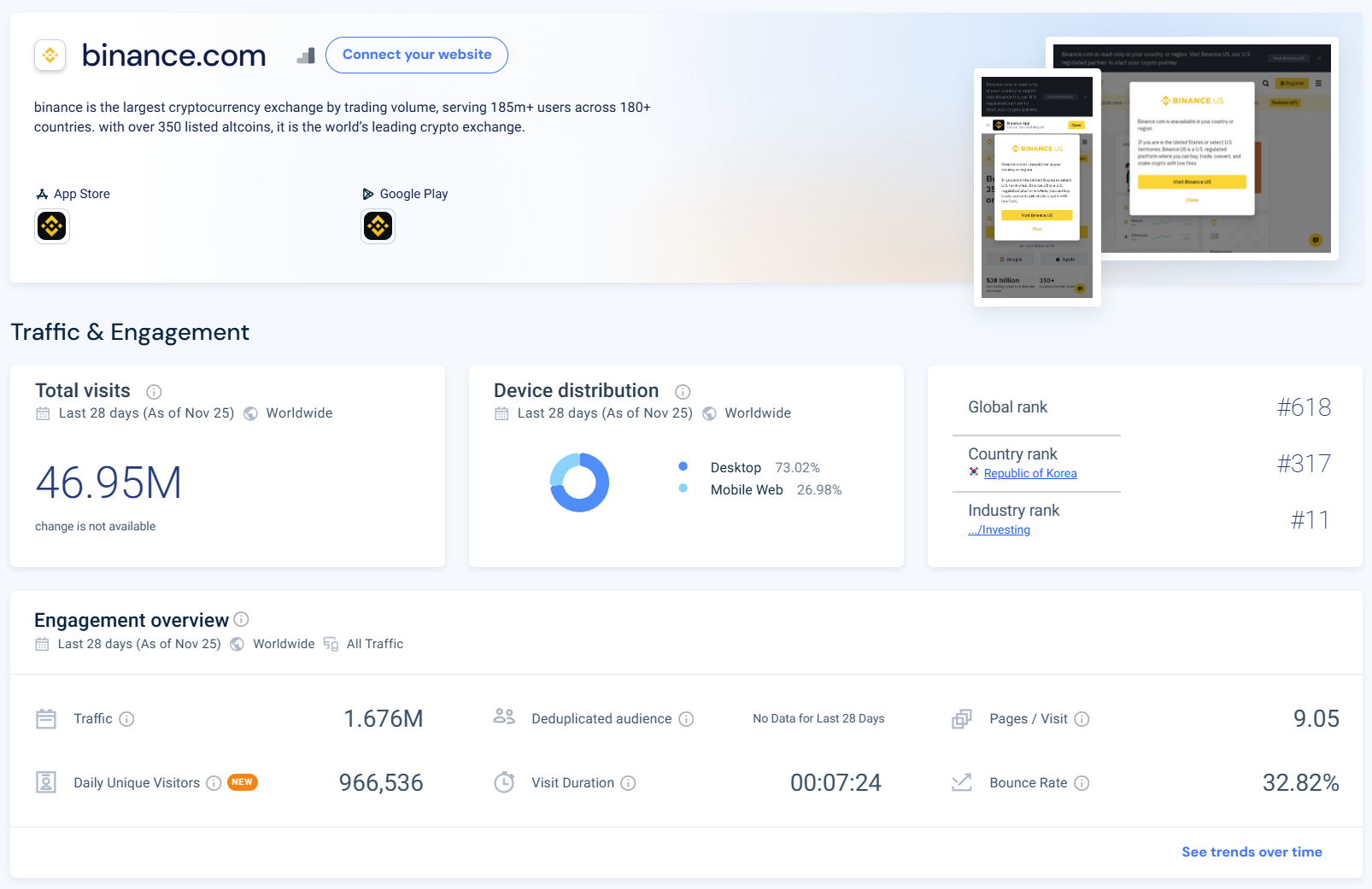
- Binance (assisted but clean) CASE STUDY
- Bybit (assisted, borderline clean)
What a Real Exchange Profile Looks Like
The Fake (Mixed) Exchanges
Fake here does not mean “zero real users.” These exchanges DO have organic traffic, real traders, and active communities. The issue is that they also run a large volume of fake visits on top of that real traffic.
Their traffic profile is mixed:
- a genuine, organic user base
- plus a significant layer of fake visits
- plus additional traffic coming from the same ring used by the ugly exchanges
This mix is why their averages fall into the 20–40 seconds per page synthetic zone. The fake portion contaminates real behavior and drags the ratio out of the human band.
Important: These exchanges are not clean. They are active members of the very same traffic ring that powers the ugly exchanges. The difference is that mixed exchanges still retain meaningful organic traffic and marketing sources, so their profiles do not collapse completely into the ugly category.
Typical mixed-traffic exchanges:
- Gate
- UPBIT
- XT
- Bitget
- KuCoin CASE STUDY
- MEXC CASE STUDY
Timeline of contamination:
- Gate – adopted ring traffic first (around May 2025), previously a Real Exchange
- XT – followed Gate shortly after (around June 2025), previously a Real Exchange
- Bitget – joined after XT (around July 2025), previously a Real Exchange
- KuCoin – completely clean through August, joined the ring in September 2025
- MEXC – completely clean through October, joined freshly in November 2025
In every case, the shift was unmistakable: page views exploded overnight, bounce collapsed, and time-per-page dropped straight into the synthetic 20–40 second range.
Before & After: How Ring Traffic Changes an Exchange Overnight
Below are two real examples showing how a clean exchange looks just before joining the ring — and how the metrics shift immediately after. The pattern is identical across every exchange that becomes a ring member.
KuCoin — Before Ring Traffic (Clean / August 2025)

KuCoin in August — completely clean profile.
Human visit duration (3m 56s), normal pages/visit (3.50), people stayed on each page for about 67 seconds — that’s real human reading time, natural bounce (40.10%), and healthy mobile usage (25.64%).
KuCoin — After Joining the Ring (September 2025)

Visit duration (10m 09s), pages/visit (16.50), people stayed on each page for about 36 seconds — too fast for real browsing, mobile unchanged (~26%), rhythm no longer human.
MEXC — Before Ring Traffic (Clean / October 2025)

MEXC in October — fully organic.
Balanced engagement, people stayed on each page for about 51 seconds — real human reading time, with no signs of synthetic activity.
MEXC — After Joining the Ring (November 2025)

MEXC in November — immediate ring contamination.
Page depth jumps, visit duration shifts, and people stayed on each page for only about 40 seconds — a clear drop out of the human range.
Mixed platforms are not “ghost towns.” They still have real communities and real traders. But once ring traffic becomes part of the mix, their engagement no longer reflects pure human behavior — the contamination is visible in every metric.
Mixed traffic is still fake traffic. It’s simply blended with enough organic volume to appear healthier on the surface without ever entering the real-traffic band.
The Ugly Exchanges (Where Fake Visits Dominate)
Ugly exchanges go far beyond mixed behavior. These platforms rely almost entirely on fake visits, with 95%–99% of their traffic coming directly from the same rotation ring shared across dozens of low-quality exchanges.
Some ugly exchanges get a tiny trickle of organic traffic (thanks to being listed on CMC, or from occasional random clicks), but the reality is simple:
Ugly = almost no real users. The ring traffic does all the heavy lifting.
The result is unmistakable:
- time per page under 20 seconds
- bounce under 15%
- 20+ pages per visit
- long “visit duration” caused only by loops
- weak or near-zero mobile usage
This is not “slightly mixed.” This is pure rotation-loop activity. The same forced visitor is pushed through multiple exchanges in the ring before exiting — creating a synthetic appearance of engagement.
Examples from the ugly hall of fame (the pure ring-driven platforms):
- 👑 LBank
- 👑 CoinW
- 👑 HTX
- Weex
- Tapbit CASE STUDY
- Orangex
- CoinUp
- Safex
- Bitcastle
- HIBT
- Toobit
- Bitmart
- Ourbit
- Sunx
- JU
- BTSE
- Biconomy
- UZX
- BTCC
- VOOX
- Hotcoin
- Azbit
- Bifinance
- TossInvest
These exchanges are dominated by fake visits. Their metrics make that painfully obvious: extremely low bounce, extremely high pages-per-visit, near-zero mobile, and almost no real engagement.
The Three Kings of Fake Traffic (A Closer Look)

Nearly all visits match ring-driven behavior: people stayed on each page for only about 17 seconds (far too fast for real users), page depth is extreme (38+ pages per visit), mobile usage is almost nonexistent (≈3%), and bounce is unnaturally suppressed (7%).

People stayed on each page for only about 17 seconds (far too fast for real users), page depth is extreme (37+ pages per visit), mobile usage is almost nonexistent (≈1.4%), and bounce is unnaturally suppressed (8%).

People stayed on each page for only about 13 seconds (far too fast for real users), page depth is extreme (49+ pages per visit), mobile usage is almost nonexistent (≈1.3%), and bounce is unnaturally suppressed (9%).
The Traffic Ring Explained
What the traffic ring is: a closed-loop system where recycled traffic moves continuously between all member exchanges 24/7. These visits do not land on real pages — they hit doorway URLs made for rapid traffic exchange.
Every exchange inside the ring acts as both an incoming and outgoing source of traffic. This creates identical referral patterns, identical timing, and identical synthetic behavior signatures across all members. Competing exchanges literally inflate each other’s stats by sending fake visits back and forth.
Why this matters: the ring is the reason so many exchanges show the same suspicious profiles — extremely low bounce, abnormal page depth, and non-human visit duration. The more members the ring has, the bigger the illusion becomes.
Why Only a Few Exchanges Get It Right
Only a small number of exchanges maintain clean, human ratios, because they rely on real users instead of shortcuts:
- a genuine organic user base
- global traffic consistency
- strong mobile and app engagement
- real traders spending time on charts and pages
- no dependence on rotation loops
They may boost traffic occasionally, but they never let synthetic visits dominate the profile. Human behavior stays visible in every metric.
What Not To Look At
Most people focus on the wrong numbers:
- total visits
- rank
- search volume
- country list
- visit growth
- direct traffic percentage
All of these can be inflated with fake visits.
Behavioral metrics are different. Time-per-page, mobile share, and bounce are much harder to fake consistently across millions of visits.
How Exchanges Actually Compete
At the traffic level, exchanges are not just competing on technology or fees. They are competing on appearance:
- who looks bigger
- who looks more liquid
- who looks more active
- who appears highest ranked
- who appears to have the most users
Ranking, liquidity appearance, and traffic footprint all feed into trust. Traders and projects naturally drift toward platforms that look busy and alive.
Fake traffic is the shortcut some exchanges take to win that visual arms race.
If a future case study is added, it will appear in this category along with the others.
Final Checklist: Spotting Real, Fake, and Ugly Exchanges
Use this as a quick reference:
Real visits (healthy exchanges)
- 50+ sec/page
- 3–8 pages/visit
- 30–60% bounce
- meaningful mobile share (20% and up)
Fake (mixed) visits
- 20–40 sec/page
- 10–15 pages/visit
- <30% bounce
- mobile looks “okay” but behavior feels off
Ugly fake visits
- <20 sec/page
- 25+ pages/visit
- <20% bounce
- low or near-zero mobile usage
Once you see these patterns a few times, you cannot unsee them.
Why This Matters
Fake traffic is not just a cosmetic issue. It has real consequences:
- misleads traders
- manipulates rankings
- hides real user activity
- inflates exchange status
- supports fake volume
- makes the market look bigger and healthier than it is
Understanding traffic behavior is a small step toward a more honest industry.
Conclusion: Traffic Does Not Lie
Crypto exchanges fall into three reputation tiers:
- The Real – real visits dominate
- The Fake – mixed visits contaminate the profile
- The Ugly – fake visits dominate
Visit counts can be faked. Rankings can be gamed. Volume can be inflated.
But:
- Traffic does not lie.
- Time-per-page does not lie.
- Ratios do not lie.
- Exchanges do.
Real visits are earned.
Fake visits are bought.
Ugly visits are forced.
The ratio tells you which is which.